Location preference

Enter your country so we can show you products that are available for you.

News Release

For platelet donations, data is essential

How a blood center in Brazil is strengthening donor safety, loyalty, and platelet supply by leveraging insights from integrated digital monitoring


On any given day, blood donors arrive with different motivations — a loved one in need, a personal commitment to service, or simply a desire to give back. What they share is trust: that donation centers will safeguard their well‑being and their time. Platelet apheresis asks more of donors than traditional blood donation — longer sessions, focused procedures — and in return, blood centers owe them predictable, safe, and respectful experiences.

That promise carries particular weight in Brazil, where recurring dengue outbreaks can increase demand for platelet transfusions.1 Major medical centers also care for large numbers of cancer, transplant, and surgical patients who depend on platelets as part of routine treatment.2  In addition, trauma and critical care patients worldwide often require platelet transfusions as part of modern resuscitation protocols, contributing to sustained demand in tertiary centers.3,4

Because platelet apheresis takes significantly longer — about 90 minutes versus 15 minutes for a traditional donation5 — and requires greater donor engagement, protecting the donor experience is as essential to protecting the supply itself.

At Beneficência Portuguesa São Paulo — one of the largest private hospitals in Latin America6 — the team wanted to understand what truly shapes a donor’s willingness to return. Not just what donors say, but what they actually do.

They launched a prospective observational study to examine how even minor adverse events (AEs) influence donor satisfaction and behavior over time.7 Using the Trima Accel™ Automated Blood Collection System for platelet collections and TOMEs™ (Terumo Operational Medial Equipment Software) to consolidate and interpret operational insights, they set out to quantify the blood donor experience.

What the data revealed7

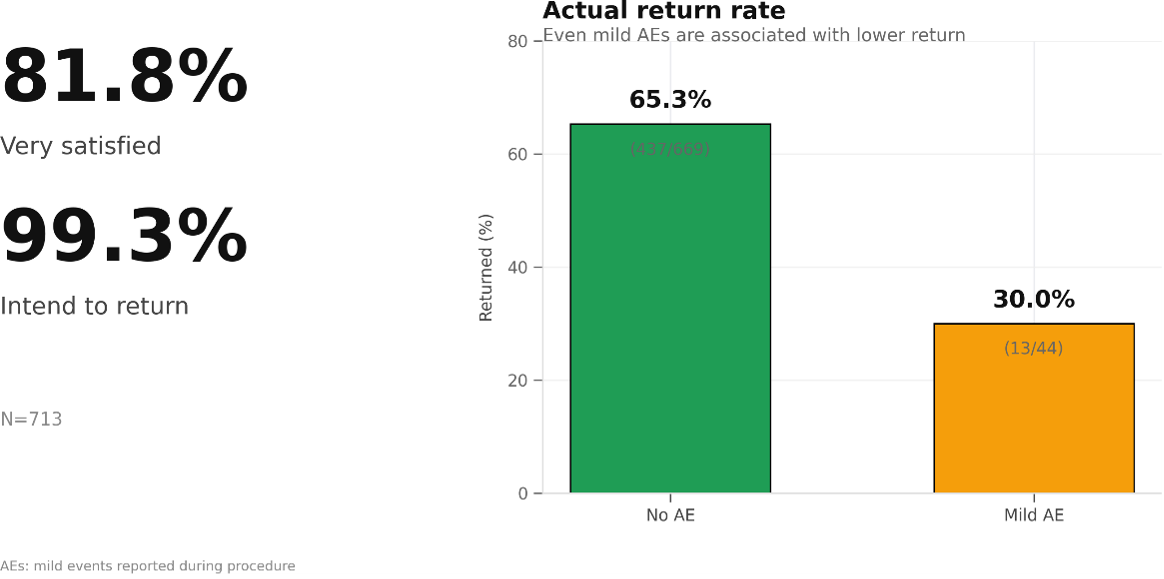
Across 713 platelet donations, donor sentiment was highly positive: More than 80% reported being very satisfied, and nearly all said they intended to return. Adverse events were uncommon and mild, occurring in just over 6% of procedures.

Yet, when software made it possible to link these events with actual donor behavior, a critical gap emerged.

Donors who experienced no adverse event returned at more than twice the rate of those who experienced even a mild one (65.3% vs. 30.0%). By connecting procedure data, donor feedback, and return behavior, researchers were able to measure the relationship between adverse events and donor return rates — demonstrating how digital systems can transform routine data into actionable insights about the donor experience.

Figure 1: Donors who experienced a mild adverse event had lower actual return rates despite high overall satisfaction and intent to return.

From data to understanding*

With Trima Accel and TOMEs, the Beneficência Portuguesa team now has visibility that wasn’t possible with manual or fragmented tracking. By linking donor experience data with actual return behavior, they can identify opportunities where changes in donation procedure or donor communication may have a positive impact on donor confidence and loyalty.

Over time, this type of evidence-based understanding can support ongoing evaluation of donor engagement strategies, refinement of chairside practices, and broader discussions about how hemovigilance data can contribute not only to safety, but also to the long-term resilience of platelet supply.

When the donor experience improves, the entire system gets stronger

The findings from Beneficência Portuguesa reinforce an important truth: Platelet donors give more of their time, and their experience matters, as even the smallest aspects of a procedure can influence whether they return. Given the constant demand for platelets, donor loyalty is more than a program metric — it is essential to maintaining a stable blood supply and, ultimately, the healthcare system that depends on it.

By adopting digital monitoring tools that illuminate donor experience, safety, and behavior, centers can protect not only the donors who walk through their doors, but also the patients whose lives depend on every unit they give.

References

1.      Oliveira DS, Britto DG, de Sá GF, et al. Blood components requirement in Brazilian dengue outbreaks: A retrospective analysis between 2008 to 2019. Hematol Transfus Cell Ther. 2024;46(4):381-386. doi:10.1016/j.htct.2023.07.006

2.      International Society of Blood Transfusion. Platelet transfusion in adults. ISBT. Updated January 2026. Accessed July 8, 2026. https://www.isbtweb.org/isbt-working-parties/clinical-transfusion/resources/patient-blood-management-resources/5-platelet-transfusion-in-adults.html

3.      Hamada SR, Garrigue D, Nougue H, et al. Impact of platelet transfusion on outcomes in trauma patients. Crit Care. 2022;26(1):49. doi:10.1186/s13054-022-03928-y 

4.      Stefely JA, Manis JP. Form follows function for freeze-dried platelets. Am J Hematol. 2022;97(3):253-255. doi:10.1002/ajh.26460

5.      National Institutes of Health Clinical Center. Donating platelets by apheresis. Accessed July 8, 2026. https://www.cc.nih.gov/bloodbank/platelets

6.      de Oliveira A, Couto TAPP. The development of uniportal video-assisted thoracoscopic surgery in São Paulo: from diagnosis to lobectomy. J Thorac Dis. 2017;9(4):865-870. doi:10.21037/jtd.2016.10.79

7.      De Nadai LC, Oliveira SC, Battaglini RP, Silva R, Cardoso M. Ocorrência de eventos adversos e satisfação do doador de aférese com Trima Accel™/TOMEs™ no Banco de Sangue da Beneficência Portuguesa de São Paulo. Poster presented at Hemo 2025 (Congresso Brasileiro de Hematologia, Hemoterapia e Terapia Celular), São Paulo, Brazil, 2025. https://www.htct.com.br/pt-ocorrencia-de-eventos-adversos-e-articulo-S2531137925018632


*Disclaimer: This case study highlights the experiences, perspectives, and operational outcomes observed at Beneficência Portuguesa São Paulo based on a prospective observational study conducted between November 2024 and June 2025. The findings reflect the specific practices, donor population, clinical environment, and operational conditions at this institution and may not be representative of outcomes at other blood centers or predictive of future results. Individual results, efficiencies, and donor behaviors may vary based on local protocols, staffing, donor demographics, and regional healthcare needs. The insights described represent the views and experiences of this facility and do not necessarily reflect the views of Terumo Blood and Cell Technologies.

Product availability and indications are subject to applicable regulatory approvals and may vary by country.

Trima Accel™ and TOMEs™ are trademarks or registered trademarks of Terumo BCT, Inc. in the United States and/or other countries. For a full list of trademarks, please visit TerumoBCT.com/Trademarks. Trima Accel and TOMEs are not available for purchase by the general public.

To top